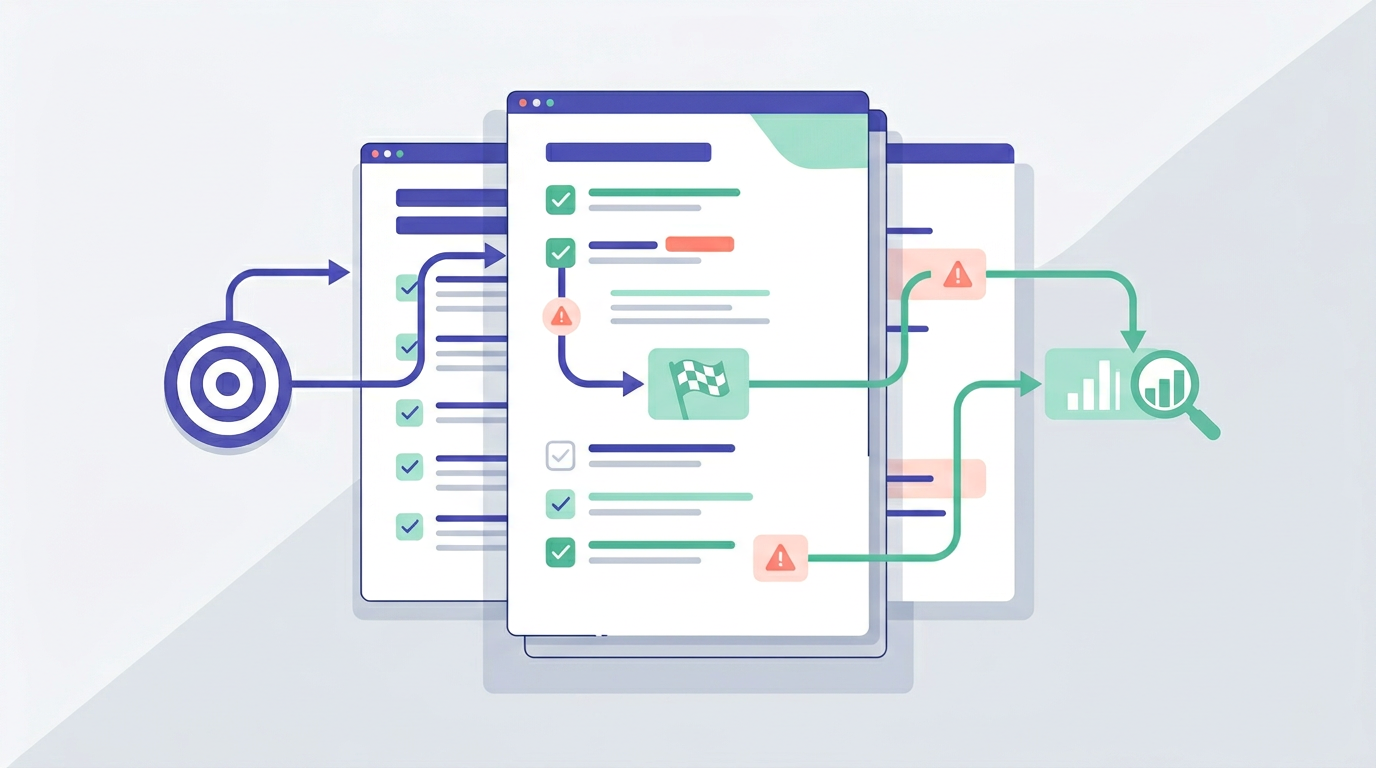
Standard spell checks and copy-editing only catch surface-level mistakes. The real risks for a regulatory dossier hide deeper — in the document's logical structure. ClinScriptum is built to surface exactly those non-obvious inconsistencies. Here are five examples.
1. A broken "Golden Triangle"
Problem: The Protocol declares an ambitious objective (e.g., "demonstrate superiority of drug A over placebo"), but no matching primary endpoint is defined, or no adequate statistical analysis method is specified for it.
How ClinScriptum catches it: The system builds a graph of "Objective → Endpoint → Analysis method" relationships. A broken link in that chain triggers a critical warning.
2. Inclusion criteria that conflict with procedures
Problem: "Patients with renal insufficiency" was added to the exclusion criteria, but the Schedule of Activities (SoA) still contains group-specific assays copied over from another study.
How ClinScriptum catches it: By analysing the semantics of the Knowledge Base, the system maps the population against the assigned procedures and surfaces logical conflicts.
3. Washout period misaligned with T1/2
Problem: A bioequivalence study sets the washout period at 7 days, while the half-life (T1/2) of the drug — per the Investigator's Brochure — is 48 hours (a minimum of 10 days is required).
How ClinScriptum catches it: The BE audit module deliberately extracts these two parameters from different documents (Protocol and IB) and reconciles them according to ICH guidance (5 × T1/2).
4. "Blind spots" in visit descriptions
Problem: The SoA table lists "blood sample for pharmacokinetics", but the textual description of Visit 3 doesn't mention this procedure at all.
How ClinScriptum catches it: The system builds a complete map of procedures from the SoA table and verifies their presence in the textual description of each visit, surfacing any gaps.
5. Ambiguous wording
Problem: The safety section says "adverse events will be recorded periodically", with no precise timing or methodology. This kind of phrasing is guaranteed to draw a question from the regulator.
How ClinScriptum catches it: Using an LLM assistant trained on regulatory expectations, the system flags vague or imprecise phrasing and proposes more concrete replacements.
Bottom line: An automated logical audit isn't a replacement for the writer's expertise — it's a force multiplier that frees their time from mechanical reconciliation so they can focus on higher-order work.